https://blog.lemonhall.me/notesview/show/625
首选需要解决管理多版本的问题
uv python install cpython-3.8.20-windows-x86_64-none然后就可以开始了:
uv init lightrag_demo --python 3.8.20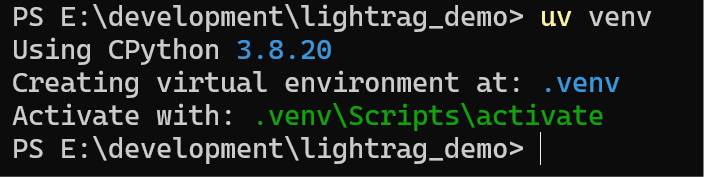
初始化好一个3.8.20的虚拟环境
激活
.venv\Scripts\activate
https://github.com/HKUDS/LightRAG
克隆仓库:
git clone https://github.com/HKUDS/LightRAG.gitcd LightRAG
pip install -e .Collecting gensim<=3.9.0,>=3.8.0 (from graspologic->lightrag-hku==1.1.6)
Using cached https://pypi.tuna.tsinghua.edu.cn/packages/
a0/b4/f4e45875a4cb1c4f6a76d6d07a2981753aab5f135dac2381f625e8807542/
gensim-3.8.3.tar.gz (23.4 MB)
Installing build dependencies ... done
Getting requirements to build wheel ... done
Installing backend dependencies ... done
Preparing metadata (pyproject.toml) ... error
error: subprocess-exited-with-error
× Preparing metadata (pyproject.toml) did not run successfully.
│ exit code: 1
╰─> [78 lines of output]
C:\Users\lemon\AppData\Local\Temp\pip-build-env-tknh_s8g\overlay\Lib
\site-packages\setuptools\_distutils\dist.py:270: UserWarning: Unknown distribution option: 'test_suite'
warnings.warn(msg)
C:\Users\lemon\AppData\Local\Temp\pip-build-env-tknh_s8g\overlay\Lib\
site-packages\setuptools\_distutils\dist.py:270: UserWarning: Unknown distribution option: 'tests_require'
warnings.warn(msg)
running dist_info
creating C:\Users\lemon\AppData\Local\Temp\pip-modern-metadata-ntyec0iz\gensim.egg-info
writing C:\Users\lemon\AppData\Local\Temp\pip-modern-metadata-ntyec0iz\gensim.egg-info\PKG-INFO
writing dependency_links to C:\Users\lemon\AppData\Local\Temp\pip-modern-metadata-ntyec0iz\
gensim.egg-info\dependency_links.txt
writing requirements to C:\Users\lemon\AppData\Local\Temp\pip-modern-metadata-ntyec0iz\
gensim.egg-info\requires.txt
writing top-level names to C:\Users\lemon\AppData\Local\Temp\pip-modern-metadata-ntyec0iz\
gensim.egg-info\top_level.txt
writing manifest file 'C:\Users\lemon\AppData\Local\Temp\pip-modern-metadata-ntyec0iz\gensim.egg-info\SOURCES.txt'
Traceback (most recent call last):
File "C:\Python313\Lib\site-packages\pip\_vendor\pyproject_hooks\_in_process\_in_process.py",
line 389, in <module>
main()
~~~~^^
File "C:\Python313\Lib\site-packages\pip\_vendor\pyproject_hooks\_in_process\_in_process.py",
line 373, in main
json_out["return_val"] = hook(**hook_input["kwargs"])
~~~~^^^^^^^^^^^^^^^^^^^^^^^^
File "C:\Python313\Lib\site-packages\pip\_vendor\pyproject_hooks\_in_process\_in_process.py",
line 175, in prepare_metadata_for_build_wheel
return hook(metadata_directory, config_settings)
File "C:\Users\lemon\AppData\Local\Temp\pip-build-env-tknh_s8g\overlay\Lib\site-packages\setuptools\build_meta.py",
line 377, in prepare_metadata_for_build_wheel
self.run_setup()
~~~~~~~~~~~~~~^^
File "C:\Users\lemon\AppData\Local\Temp\pip-build-env-tknh_s8g\overlay\Lib\site-packages\setuptools\build_meta.py",
line 522, in run_setup
super().run_setup(setup_script=setup_script)
~~~~~~~~~~~~~~~~~^^^^^^^^^^^^^^^^^^^^^^^^^^^
File "C:\Users\lemon\AppData\Local\Temp\pip-build-env-tknh_s8g\overlay\Lib\site-packages\setuptools\build_meta.py",
line 320, in run_setup
exec(code, locals())
~~~~^^^^^^^^^^^^^^^^
File "<string>", line 367, in <module>
File "C:\Users\lemon\AppData\Local\Temp\pip-build-env-tknh_s8g\overlay\Lib\site-packages\setuptools\__init__.py",
line 117, in setup
return distutils.core.setup(**attrs)
~~~~~~~~~~~~~~~~~~~~^^^^^^^^^
File "C:\Users\lemon\AppData\Local\Temp\pip-build-env-tknh_s8g\overlay\Lib\site-packages\setuptools\_distutils\core.py",
line 186, in setup
return run_commands(dist)
File "C:\Users\lemon\AppData\Local\Temp\pip-build-env-tknh_s8g\overlay\Lib\site-packages\setuptools\_distutils\core.py",
line 202, in run_commands
dist.run_commands()
~~~~~~~~~~~~~~~~~^^
File "C:\Users\lemon\AppData\Local\Temp\pip-build-env-tknh_s8g\overlay\Lib\site-packages\setuptools\_distutils\dist.py",
line 983, in run_commands
self.run_command(cmd)
~~~~~~~~~~~~~~~~^^^^^
File "C:\Users\lemon\AppData\Local\Temp\pip-build-env-tknh_s8g\overlay\Lib\site-packages\setuptools\dist.py",
line 999, in run_command
super().run_command(command)
~~~~~~~~~~~~~~~~~~~^^^^^^^^^
File "C:\Users\lemon\AppData\Local\Temp\pip-build-env-tknh_s8g\overlay\Lib\site-packages\setuptools\_distutils\dist.py",
line 1002, in run_command
cmd_obj.run()
~~~~~~~~~~~^^
File "C:\Users\lemon\AppData\Local\Temp\pip-build-env-tknh_s8g\overlay\Lib\site-packages\
setuptools\command\dist_info.py", line 94, in run
self.egg_info.run()
~~~~~~~~~~~~~~~~~^^
File "C:\Users\lemon\AppData\Local\Temp\pip-build-env-tknh_s8g\overlay\Lib\site-packages\
setuptools\command\egg_info.py", line 312, in run
self.find_sources()
~~~~~~~~~~~~~~~~~^^
File "C:\Users\lemon\AppData\Local\Temp\pip-build-env-tknh_s8g\overlay\Lib\site-packages\
setuptools\command\egg_info.py", line 320, in find_sources
mm.run()
~~~~~~^^
File "C:\Users\lemon\AppData\Local\Temp\pip-build-env-tknh_s8g\overlay\Lib\site-packages\
setuptools\command\egg_info.py", line 543, in run
self.add_defaults()
~~~~~~~~~~~~~~~~~^^
File "C:\Users\lemon\AppData\Local\Temp\pip-build-env-tknh_s8g\overlay\Lib\site-packages\
setuptools\command\egg_info.py", line 581, in add_defaults
sdist.add_defaults(self)
~~~~~~~~~~~~~~~~~~^^^^^^
File "C:\Users\lemon\AppData\Local\Temp\pip-build-env-tknh_s8g\overlay\Lib\site-packages\
setuptools\command\sdist.py", line 109, in add_defaults
super().add_defaults()
~~~~~~~~~~~~~~~~~~~~^^
File "C:\Users\lemon\AppData\Local\Temp\pip-build-env-tknh_s8g\overlay\Lib\site-packages\
setuptools\_distutils\command\sdist.py", line 239, in add_defaults
self._add_defaults_ext()
~~~~~~~~~~~~~~~~~~~~~~^^
File "C:\Users\lemon\AppData\Local\Temp\pip-build-env-tknh_s8g\overlay\Lib\site-packages\
setuptools\_distutils\command\sdist.py", line 323, in _add_defaults_ext
build_ext = self.get_finalized_command('build_ext')
File "C:\Users\lemon\AppData\Local\Temp\pip-build-env-tknh_s8g\overlay\Lib\site-packages\
setuptools\_distutils\cmd.py", line 316, in get_finalized_command
cmd_obj.ensure_finalized()
~~~~~~~~~~~~~~~~~~~~~~~~^^
File "C:\Users\lemon\AppData\Local\Temp\pip-build-env-tknh_s8g\overlay\Lib\site-packages\
setuptools\_distutils\cmd.py", line 124, in ensure_finalized
self.finalize_options()
~~~~~~~~~~~~~~~~~~~~~^^
File "<string>", line 111, in finalize_options
AttributeError: 'dict' object has no attribute '__NUMPY_SETUP__' and no __dict__ for
setting new attributes
[end of output]
note: This error originates from a subprocess, and is likely not a problem with pip.
error: metadata-generation-failed
× Encountered error while generating package metadata.
╰─> See above for output.
note: This is an issue with the package mentioned above, not pip.
hint: See above for details.依旧报错
pip install lightrag-hku我放弃了,用了pip的方法直接安装
import os
from lightrag import LightRAG, QueryParam
from lightrag.llm.openai import openai_embed,openai_complete
from openai import AsyncOpenAI

#########
# Uncomment the below two lines if running in a jupyter notebook to handle the async nature of rag.insert()
# import nest_asyncio
# nest_asyncio.apply()
#########


WORKING_DIR = "./dickens"

if not os.path.exists(WORKING_DIR):
    os.mkdir(WORKING_DIR)

# 删除旧数据库(如果存在)
if os.path.exists(os.path.join(WORKING_DIR, "vector_db")):
    import shutil
    shutil.rmtree(os.path.join(WORKING_DIR, "vector_db"))


rag = LightRAG(
    working_dir=WORKING_DIR,
    embedding_func=openai_embed,
    llm_model_func=openai_complete
)

with open("./book.txt", "r", encoding="utf-8-sig") as f:
    rag.insert(f.read())

# Perform naive search
print(rag.query("What are the top themes in this story?", param=QueryParam(mode="naive")))

# Perform local search
print(rag.query("What are the top themes in this story?", param=QueryParam(mode="local")))

# Perform global search
print(rag.query("What are the top themes in this story?", param=QueryParam(mode="global")))

# Perform hybrid search
print(rag.query("What are the top themes in this story?", param=QueryParam(mode="hybrid")))

# Perform mix search (Knowledge Graph + Vector Retrieval)
# Mix mode combines knowledge graph and vector search:
# - Uses both structured (KG) and unstructured (vector) information
# - Provides comprehensive answers by analyzing relationships and context
# - Supports image content through HTML img tags
# - Allows control over retrieval depth via top_k parameter
print(rag.query("What are the top themes in this story?", param=QueryParam(
    mode="mix")))
官网的例子,我跑了多少个来回都跑不通
最后修改如下:
词嵌入部分:
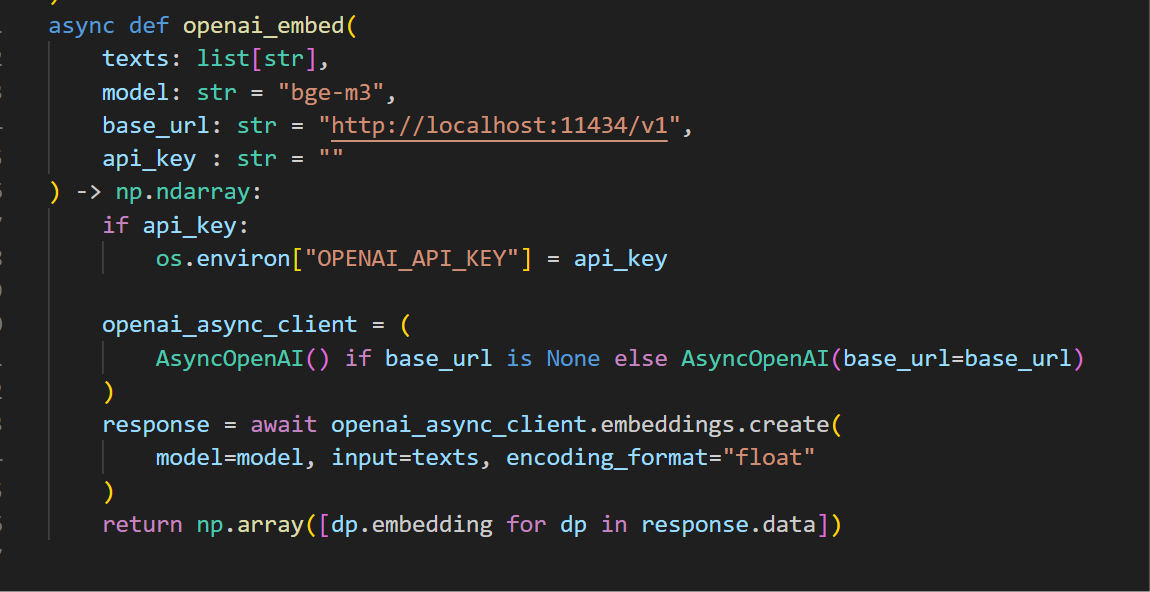
我直接硬修改了词嵌入部分,使用了本地的ollama模型做词嵌入
否则烦死了
由此带来的改变是,需要全局搜索这个lib下的文件,将向量库改成1024,以适配本地的这个词嵌入维度
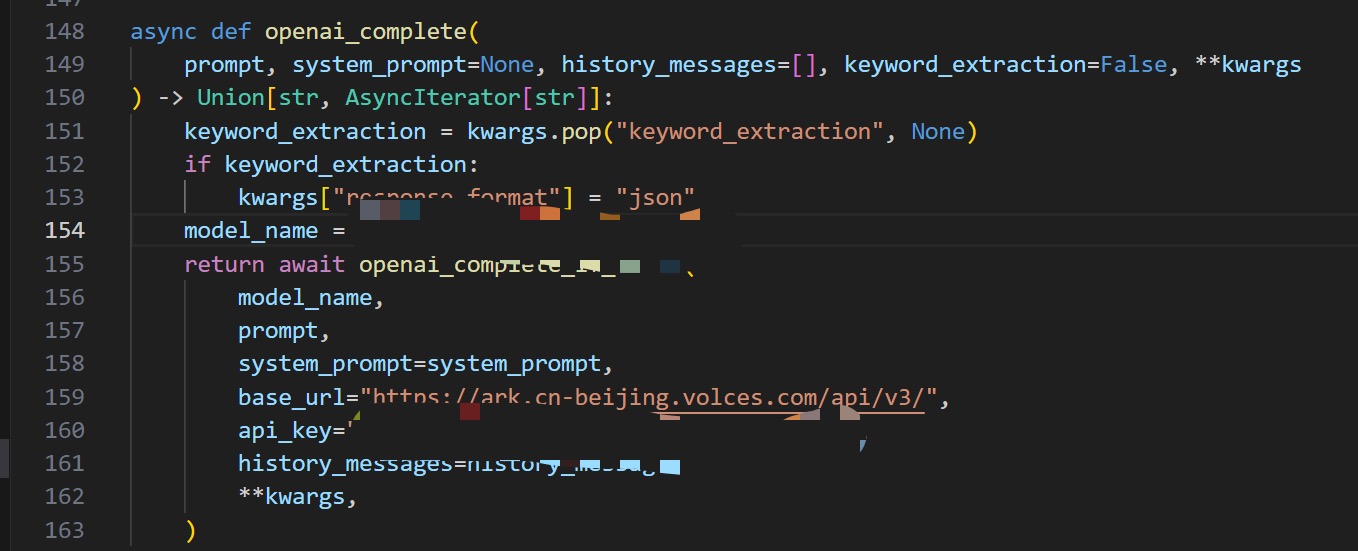
第二个修改也是实在不耐烦了
这个项目的客户端初始化这里写的非常非常的。。。。绕
有点不耐烦了,所以直接硬改了openai.py里面的代码
curl https://raw.githubusercontent.com/gusye1234/nano-graphrag/main/tests/mock_data.txt > ./book.txt下载狄更斯的这部小说
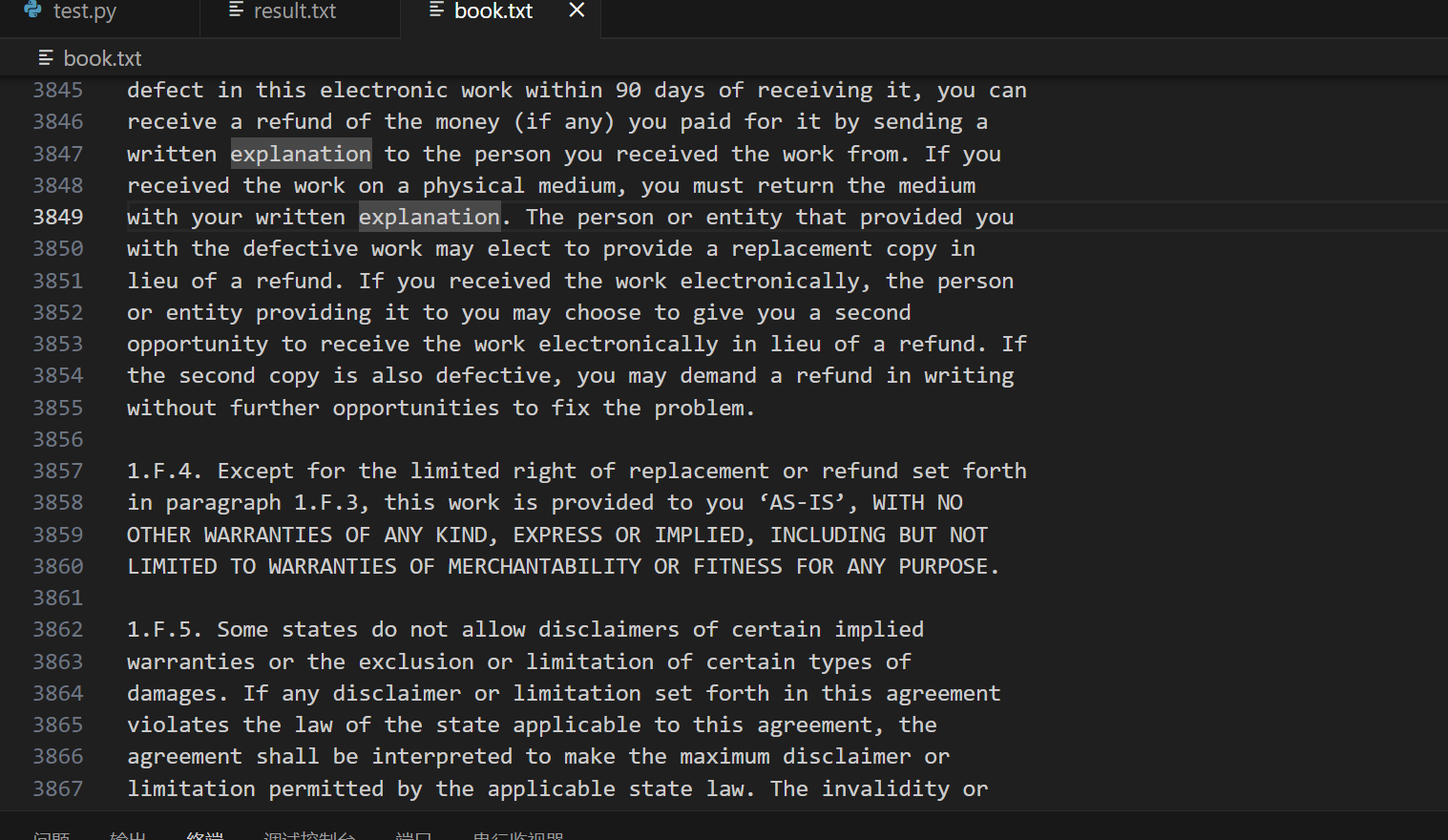
记得打开检查一下
然后就可以开始跑了:
PS E:\development\MetaChain> & C:/Python313/python.exe e:/development/MetaChain/test.py
INFO:nano-vectordb:Init {'embedding_dim': 1024, 'metric': 'cosine', 'storage_file': './dickens\\vdb_entities.json'} 0 data
INFO:nano-vectordb:Init {'embedding_dim': 1024, 'metric': 'cosine', 'storage_file': './dickens\\vdb_relationships.json'} 0 data
INFO:nano-vectordb:Init {'embedding_dim': 1024, 'metric': 'cosine', 'storage_file': './dickens\\vdb_chunks.json'} 0 data
INFO:lightrag:Loaded document status storage with 1 records
INFO:lightrag:Processing 1 new unique documents
Processing batch 1:   0%|                                                                                                    | 0/1 [00:00<?, ?it/s]INFO:lightrag:Inserting 42 vectors to chunks
Generating embeddings: 100%|██████████████████████████████████████████████████████████████████████████████████████| 2/2 [00:10<00:00,  5.15s/batch]
Generating embeddings: 100%|██████████████████████████████████████████████████████████████████████████████████████| 2/2 [00:10<00:00,  5.08s/batch]INFO:lightrag:Inserting 528 vectors to entities
Generating embeddings: 100%|████████████████████████████████████████████████████████████████████████████████████| 17/17 [00:27<00:00,  1.63s/batch]
INFO:lightrag:Inserting 493 vectors to relationships████████████████████████████████████████████████████████████| 17/17 [00:27<00:00,  1.91batch/s]
Generating embeddings: 100%|████████████████████████████████████████████████████████████████████████████████████| 16/16 [00:27<00:00,  1.71s/batch]
INFO:lightrag:Writing graph with 537 nodes, 493 edges███████████████████████████████████████████████████████████| 16/16 [00:27<00:00,  1.21s/batch]
Processing batch 1: 100%|███████████████████████████████████████████████████████████████████████████████████████████| 1/1 [07:45<00:00, 465.98s/it]
INFO:lightrag:Query: What are the top themes in this story?, top_k: 60, cosine: 0.2
INFO:lightrag:Truncate 42 to 3 chunks


### Top Themes in the Story

#### 1. **Moral Corruption and Greed**
The interactions at Old Joe’s shop reveal a bleak underbelly of human behavior. Characters like the charwoman, laundress, and undertaker’s man trade stolen goods from the deceased, highlighting greed and moral decay. Their callous dismissal of the dead man (“*a wicked old screw*”) critiques selfishness and the consequences of a life devoid of compassion.

#### 2. **Isolation vs. Community**
Scrooge’s solitary, frosty existence (“*solitary as an oyster*”) contrasts sharply with scenes of communal joy. Miners, lighthouse keepers, and sailors celebrate Christmas together despite harsh conditions, emphasizing resilience through human connection. Even the impoverished characters at Old Joe’s find camaraderie in their shared opportunism.

#### 3. **Redemption and Transformation**
Scrooge’s journey with the Spirits forces him to confront his misanthropy. His nephew’s infectious laughter and the vision of his own lonely death (“*gasping out his last there, alone*”) underscore the possibility—and urgency—of change. The story arcs toward Scrooge’s potential redemption, critiquing rigid self-interest.

#### 4. **Social Inequality and Exploitation**
The impoverished characters’ theft of the dead man’s possessions reflects desperation born of poverty. Meanwhile, Scrooge’s refusal to heat his clerk’s workspace (“*the clerk’s fire was so very much smaller*”) illustrates systemic neglect of the working class. The narrative critiques wealth hoarding and societal indifference.

#### 5. **The Supernatural as a Mirror**
The Spirits (and visions like the miners’ celebration or the ship at sea) act as catalysts for self-reflection. They expose Scrooge to marginalized perspectives, challenging his worldview and emphasizing accountability beyond the material world.

#### 6. **The Power of Christmas Spirit**
Despite darkness, moments like Scrooge’s nephew’s laughter (“*irresistibly contagious*”) and the lighthouse keepers’ toast to “Merry Christmas” symbolize hope. The story frames Christmas as a time for empathy to transcend hardship, urging reconciliation and generosity.

---
These themes intertwine to critique Victorian social inequity while advocating for compassion and human connection as antidotes to moral decay.
INFO:lightrag:Using local mode for query processing
INFO:lightrag:Query: Character development, Plot structure, Symbolism, Motifs, Narrative techniques, top_k: 60, cosine: 0.2
INFO:lightrag:Local query uses 60 entites, 95 relations, 3 text units


### Top Themes in "A Christmas Carol"

#### 1. **Redemption**
Scrooge's transformation from miser to benefactor forms the narrative backbone. This theme is repeatedly emphasized through his supernatural-guided journey to confront past neglect, present isolation, and future consequences. The story positions redemption as achievable through self-awareness and moral accountability, with Scrooge vowing to "honor Christmas in his heart" year-round.

#### 2. **Christmas Spirit**
The holiday symbolizes generosity, forgiveness, and communal joy. Key manifestations include:
- Fezziwig’s festive celebrations contrasting with Scrooge’s earlier disdain
- The Cratchits’ poverty-defying merriment
- Scrooge’s final acts of charity (e.g., the prize turkey gift)

#### 3. **Moral Lessons**
Embedded throughout are ethical imperatives about:
- Social responsibility (Portly Gentlemen’s charity appeals)
- Consequences of greed (Marley’s chain symbolism)
- Human connection’s transformative power (Fred’s defense of Christmas)

#### 4. **Supernatural Intervention**
The Ghosts of Christmas Past/Present/Future and Marley’s spirit drive the plot. Their visitations:
- Force confrontation with repressed memories
- Reveal societal impacts of Scrooge’s actions
- Serve as metaphysical judges of human behavior

#### 5. **Loneliness vs. Community**
#### 5. **Loneliness vs. Community**
Contrasts permeate the narrative:
- Scrooge’s childhood abandonment at boarding school vs. the Cratchits’ tight-knit family
- Market-town’s festive camaraderie vs. Scrooge’s counting-house isolation
- Universal Christmas celebrations (lighthouse keepers, miners) vs. Scrooge’s initial rejection

#### 6. **Time’s Significance**
The story structurally and thematically explores:
- Memory’s role in identity formation
Contrasts permeate the narrative:
- Scrooge’s childhood abandonment at boarding school vs. the Cratchits’ tight-knit family
- Market-town’s festive camaraderie vs. Scrooge’s counting-house isolation
- Universal Christmas celebrations (lighthouse keepers, miners) vs. Scrooge’s initial rejection

#### 6. **Time’s Significance**
The story structurally and thematically explores:
- Memory’s role in identity formation
- Present choices’ future consequences
- Seasonal renewal as redemption metaphor
- Scrooge’s childhood abandonment at boarding school vs. the Cratchits’ tight-knit family
- Market-town’s festive camaraderie vs. Scrooge’s counting-house isolation
- Universal Christmas celebrations (lighthouse keepers, miners) vs. Scrooge’s initial rejection

#### 6. **Time’s Significance**
The story structurally and thematically explores:
- Memory’s role in identity formation
- Present choices’ future consequences
- Seasonal renewal as redemption metaphor
- Market-town’s festive camaraderie vs. Scrooge’s counting-house isolation
- Universal Christmas celebrations (lighthouse keepers, miners) vs. Scrooge’s initial rejection

#### 6. **Time’s Significance**
The story structurally and thematically explores:
- Memory’s role in identity formation
- Present choices’ future consequences
- Seasonal renewal as redemption metaphor
- Universal Christmas celebrations (lighthouse keepers, miners) vs. Scrooge’s initial rejection

#### 6. **Time’s Significance**
The story structurally and thematically explores:
- Memory’s role in identity formation
- Present choices’ future consequences
- Seasonal renewal as redemption metaphor
#### 6. **Time’s Significance**
The story structurally and thematically explores:
- Memory’s role in identity formation
- Present choices’ future consequences
- Seasonal renewal as redemption metaphor

#### 7. **Social Inequality**
- Present choices’ future consequences
- Seasonal renewal as redemption metaphor

#### 7. **Social Inequality**

#### 7. **Social Inequality**
#### 7. **Social Inequality**
Dickens highlights economic disparity through:
Dickens highlights economic disparity through:
- Poulterers’ lavish displays vs. street poverty
- Businessmen’s callous conversations about death
- Tiny Tim’s health struggles tied to the Cratchits’ financial precarity

These interconnected themes collectively argue for empathy and social responsibility as antidotes to moral decay.
INFO:lightrag:Using global mode for query processing
INFO:lightrag:Query: Story themes, Literary analysis, Narrative elements, top_k: 60, cosine: 0.2
INFO:lightrag:Global query uses 81 entites, 60 relations, 3 text units


### Principales temas en "A Christmas Carol"

#### **Redención y transformación moral**
El viaje de Ebenezer Scrooge desde la avaricia hasta la generosidad es el eje central. Su despertar moral, impulsado por las visitas de los espíritus, simboliza la capacidad humana de cambio. La relación *"REDEMPTION"* (rango 4) destaca cómo confronta su aislamiento y egoísmo para abrazar la empatía, mejorando la vida de los Cratchit y reconciliándose con su familia.

#### **Importancia de la comunidad y la generosidad**
La festividad de *"CHRISTMAS"* (rango 17) actúa como catalizador para criticar el individualismo. Contrasta la frialdad inicial de Scrooge con escenas como el banquete de los Cratchit o la celebración de Fred, donde la solidaridad y el compartir definen el "espíritu navideño". El fantasma de Marley advierte que las cadenas del egoísmo persiguen en la muerte.

#### **Crítica a la desigualdad social**
Temas como *"SURPLUS POPULATION"* (rango 2) reflejan la visión deshumanizante de Scrooge hacia los pobres, mientras Tiny Tim y la familia Cratchit personifican las consecuencias de esta indiferencia. El Espíritu de la Navidad Presente denuncia sistemas opresivos (prisiones, trabajo infantil) y enfatiza que la caridad es responsabilidad colectiva.

#### **Aislamiento vs. conexión humana**
La *"LONELINESS"* (rango 2) en el pasado de Scrooge (infancia abandonada, ruptura con Belle) contrasta con su reintegración social final. Su oficina lúgubre y su rechazo a las celebraciones familiares subrayan cómo el materialismo destruye relaciones, mientras su transformación celebra la importancia de los vínculos comunitarios.

#### **Mortalidad y legado**
Las visiones de la muerte de Scrooge (relacionadas con *"DEATH"*, rango 3) exponen el vacío de una vida sin compasión. La escena con Old Joe y los saqueadores de su cadáver revela cómo su avaricia lo condenó al olvido, mientras su redención asegura un legado positivo a través de actos como salvar a Tiny Tim.
INFO:lightrag:Using hybrid mode for query processing
INFO:lightrag:Query: Character development, Plot structure, Setting, Conflict resolution, Symbolism, top_k: 60, cosine: 0.2
INFO:lightrag:Local query uses 60 entites, 89 relations, 3 text units
INFO:lightrag:Query: Top themes, Story analysis, Literary elements, top_k: 60, cosine: 0.2
INFO:lightrag:Global query uses 84 entites, 60 relations, 3 text units


### Top Themes in "A Christmas Carol"

#### 1. **Redemption**
Scrooge’s transformation from a miserly recluse to a benevolent figure embodies the central theme of redemption. His journey is driven by supernatural interventions (the three Spirits) that force him to confront his past neglect, present indifference, and future consequences. The narrative emphasizes that moral awakening and change are possible even for those deeply entrenched in selfishness.

#### 2. **Generosity and the Christmas Spirit**
Christmas symbolizes communal joy, generosity, and human connection. The story contrasts Scrooge’s initial rejection of the holiday with its celebration by others, such as the Cratchits and Scrooge’s nephew Fred. The Ghost of Christmas Present exemplifies this theme, showcasing how kindness and shared festivity transcend poverty and hardship.

#### 3. **Social Inequality**
The Cratchits’ poverty and Tiny Tim’s plight highlight societal disparities. Scrooge’s dismissive attitude toward the poor (“surplus population”) is critiqued, while charitable figures like the Portly Gentlemen and Fred advocate for compassion. The story underscores the moral obligation to address systemic suffering.

#### 4. **Mortality and Moral Responsibility**
Confrontations with death—Marley’s fate, visions of Tiny Tim’s potential demise, and Scrooge’s own neglected grave—force reckoning with life’s impermanence. The chain Marley drags symbolizes the weight of moral neglect, urging Scrooge (and readers) to prioritize empathy over material gain.

#### 5. **Family and Community**
Family gatherings (Fezziwig’s party, Fred’s Christmas celebration) contrast with Scrooge’s isolation. The Cratchits’ resilience despite poverty and Tiny Tim’s symbolic role emphasize familial bonds as antidotes to societal coldness.

#### 6. **Materialism vs. Human Compassion**
Scrooge’s obsession with wealth (“Gain”) erodes his humanity, costing him love (Belle) and connection. His redemption hinges on rejecting transactional relationships in favor of generosity, as seen in his aid to the Cratchits and donations to charity.

These themes intertwine to critique Victorian industrial society while affirming the transformative power of empathy and collective responsibility.
INFO:lightrag:Query: What are the top themes in this story?, top_k: 10, cosine: 0.2
INFO:lightrag:Truncate 10 to 3 chunks
INFO:lightrag:Query: Character development, Plot conflict, Setting, Symbolism, Moral message, top_k: 60, cosine: 0.2
INFO:lightrag:Local query uses 60 entites, 88 relations, 3 text units
INFO:lightrag:Query: Story themes, Literary analysis, Narrative structure, top_k: 60, cosine: 0.2
INFO:lightrag:Global query uses 75 entites, 60 relations, 3 text units


### Top Themes in "A Christmas Carol"

#### 1. **Redemption and Moral Transformation**
The central theme revolves around **Scrooge’s journey from greed to generosity**. His supernatural encounters with Marley’s Ghost and the Spirits of Christmas force him to confront his past neglect, present indifference, and future isolation. Key moments include his emotional awakening at Tiny Tim’s plight and his vow to "honor Christmas in his heart" (KG: "SCROOGE'S CHANGE OF LIFE," "REDEMPTION"). The story culminates in acts of charity, such as sending the Cratchits a prize turkey and donating to the poor (DC: Scrooge’s interaction with the charity collector).

#### 2. **Social Inequality and Poverty**
The Cratchit family embodies the struggles of the working poor, with threadbare clothing, a meager Christmas feast, and Tiny Tim’s illness symbolizing systemic deprivation (KG: "POVERTY," "SURPLUS POPULATION"; DC: Bob Cratchit’s small fire and Martha’s late arrival due to work). The Ghost of Christmas Present rebukes Scrooge’s dismissal of the poor as "surplus population," critiquing Malthusian indifference to human suffering (KG: "THE GHOST").

#### 3. **Christmas as a Catalyst for Human Connection**
Christmas serves as both a temporal setting and a thematic force, contrasting Scrooge’s isolation with communal joy. Fred’s festive party, Fezziwig’s generosity, and miners/lighthouse keepers celebrating in hardship highlight the holiday’s unifying power (KG: "CHRISTMAS EVE CELEBRATION"; DC: Scrooge’s nephew defending Christmas as a time for "kindness and forgiveness").

#### 4. **Supernatural Intervention**
Marley’s Ghost and the three Spirits drive the narrative, using visions to expose Scrooge’s moral decay. The chains Marley drags symbolize greed’s spiritual consequences, while the Ghost of Christmas Yet to Come reveals Scrooge’s lonely death (KG: "THE CHAIN," "GHOST OF CHRISTMAS YET TO COME"; DC: Old Joe’s shop scene, where scavengers trade Scrooge’s stolen goods).

#### 5. **Isolation vs. Community**
Scrooge’s solitary existence—rejecting family, love, and charity—contrasts with communal warmth. Flashbacks to his childhood abandonment at school and broken engagement with Belle underscore his self-imposed emotional detachment (KG: "LONELINESS," "NEGLECT"; DC: The Cratchits’ close-knit family gathering despite poverty).

---

### References
1. [KG] "REDEMPTION," "CHRISTMAS," "POVERTY," "THE GHOST" entities and relationships.
2. [KG] "SCROOGE'S CHANGE OF LIFE," "SURPLUS POPULATION" relationships.
3. [DC] Cratchit family’s Christmas dinner scene.
4. [DC] Scrooge’s interaction with charity collectors and purchase of the turkey.
5. [DC] Old Joe’s shop and the scavengers’ dialogue.


==================================================================

PS E:\development\MetaChain> & C:/Python313/python.exe e:/development/MetaChain/test.py
INFO:nano-vectordb:初始化 {'embedding_dim': 1024, 'metric': 'cosine', 'storage_file': './dickens\vdb_entities.json'} 0 数据
INFO:nano-vectordb:初始化 {'embedding_dim': 1024, 'metric': 'cosine', 'storage_file': './dickens\vdb_relationships.json'} 0 数据
INFO:nano-vectordb:初始化 {'embedding_dim': 1024, 'metric': 'cosine', 'storage_file': './dickens\vdb_chunks.json'} 0 数据
INFO:lightrag:已加载文档状态存储,包含 1 条记录
INFO:lightrag:正在处理 1 个新的唯一文档
处理批次 1:   0%|                                                                                                    | 0/1 [00:00<?, ?it/s]INFO:lightrag:正在插入 42 个向量到 chunks
生成嵌入: 100%|██████████████████████████████████████████████████████████████████████████████████████| 2/2 [00:10<00:00,  5.15s/批次]
生成嵌入: 100%|██████████████████████████████████████████████████████████████████████████████████████| 2/2 [00:10<00:00,  5.08s/批次]INFO:lightrag:正在插入 528 个向量到 entities

生成嵌入: 100%|████████████████████████████████████████████████████████████████████████████████████| 17/17 [00:27<00:00,  1.63s/批次]
INFO:lightrag:正在插入 493 个向量到 relationships████████████████████████████████████████████████████████████| 17/17 [00:27<00:00,  1.91批次/s]
生成嵌入: 100%|████████████████████████████████████████████████████████████████████████████████████| 16/16 [00:27<00:00,  1.71s/批次]
INFO:lightrag:正在写入包含 537 个节点和 493 条边的图███████████████████████████████████████████████████████████| 16/16 [00:27<00:00,  1.21s/批次]
处理批次 1: 100%|███████████████████████████████████████████████████████████████████████████████████████████| 1/1 [07:45<00:00, 465.98s/it]
INFO:lightrag:查询: 这个故事中的主要主题是什么?, top_k: 60, cosine: 0.2
INFO:lightrag:将 42 个截断为 3 个 chunks

故事中的主要主题
1. 道德腐败与贪婪
Old Joe 商店中的互动揭示了人类行为的阴暗面。像清洁工、洗衣女工和殡仪馆员工这样的角色交易死者的被盗物品,突显了贪婪和道德堕落。他们对死者的冷漠态度(“一个邪恶的老吝啬鬼”)批判了自私和缺乏同情心的生活后果。

2. 孤立与社区
Scrooge 的孤独、冰冷的存在(“像牡蛎一样孤独”)与社区欢乐的场景形成鲜明对比。矿工、灯塔守护者和水手尽管条件艰苦,仍然一起庆祝圣诞节,强调了通过人际联系展现的韧性。即使在 Old Joe 商店的贫困角色中,他们也在共同的机会主义中找到了友情。

3. 救赎与转变
Scrooge 与幽灵的旅程迫使他面对自己的厌世情绪。他侄子的感染力笑声和他自己孤独死亡的愿景(“在那里孤独地咽下最后一口气”)强调了改变的可能性和紧迫性。故事朝着 Scrooge 可能的救赎发展,批判了僵化的自我利益。

4. 社会不平等与剥削
贫困角色偷窃死者的物品反映了贫困带来的绝望。与此同时,Scrooge 拒绝为他的职员加热工作场所(“职员的火炉非常小”)说明了工人阶级的系统性忽视。叙事批判了财富囤积和社会冷漠。

5. 超自然作为镜子
幽灵(以及像矿工庆祝或海上船只的愿景)作为自我反思的催化剂。他们让 Scrooge 接触到边缘化的视角,挑战他的世界观,并强调超越物质世界的责任。

6. 圣诞节精神的力量
尽管有黑暗,像 Scrooge 侄子的笑声(“不可抗拒的感染力”)和灯塔守护者的“圣诞快乐”祝酒词象征着希望。故事将圣诞节视为超越困难的同理心时刻,敦促和解和慷慨。

这些主题交织在一起,批判了维多利亚时代的社会不平等,同时倡导将同情和人际联系作为道德堕落的解药。

INFO:lightrag:使用本地模式进行查询处理
INFO:lightrag:查询: 角色发展, 情节结构, 象征主义, 主题, 叙事技巧, top_k: 60, cosine: 0.2
INFO:lightrag:本地查询使用 60 个实体, 95 个关系, 3 个文本单元

《圣诞颂歌》中的主要主题
1. 救赎
Scrooge 从吝啬鬼到恩人的转变构成了叙事的核心。这一主题通过他超自然引导的旅程反复强调,他面对过去的忽视、现在的孤立和未来的后果。故事将救赎定位为通过自我意识和道德责任实现的目标,Scrooge 发誓要“在心中尊重圣诞节”全年。

2. 圣诞节精神
节日象征着慷慨、宽恕和社区欢乐。关键表现包括:

Fezziwig 的节日庆祝与 Scrooge 早期的蔑视形成对比
Cratchit 一家尽管贫困却依然欢乐
Scrooge 最后的慈善行为(例如赠送火鸡)
3. 道德教训
贯穿始终的是关于以下内容的道德命令:

社会责任(Portly Gentlemen 的慈善呼吁)
贪婪的后果(Marley 的链条象征)
人际联系的变革力量(Fred 对圣诞节的辩护)
4. 超自然干预
圣诞过去/现在/未来的幽灵和 Marley 的灵魂推动了情节。他们的访问:

强迫面对被压抑的记忆
揭示 Scrooge 行为的社会影响
作为人类行为的形而上法官
5. 孤独与社区
5. 孤独与社区
对比贯穿叙事:

Scrooge 在寄宿学校的童年被遗弃与 Cratchit 一家的紧密家庭形成对比
市场小镇的节日友情与 Scrooge 的账房孤立形成对比
普遍的圣诞节庆祝(灯塔守护者、矿工)与 Scrooge 最初的拒绝形成对比
6. 时间的重要性
故事在结构和主题上探索:

记忆在身份形成中的作用 对比贯穿叙事:
Scrooge 在寄宿学校的童年被遗弃与 Cratchit 一家的紧密家庭形成对比
市场小镇的节日友情与 Scrooge 的账房孤立形成对比
普遍的圣诞节庆祝(灯塔守护者、矿工)与 Scrooge 最初的拒绝形成对比
6. 时间的重要性
故事在结构和主题上探索:

记忆在身份形成中的作用
当前选择的未来后果
季节性更新作为救赎的隐喻
Scrooge 在寄宿学校的童年被遗弃与 Cratchit 一家的紧密家庭形成对比
市场小镇的节日友情与 Scrooge 的账房孤立形成对比
普遍的圣诞节庆祝(灯塔守护者、矿工)与 Scrooge 最初的拒绝形成对比
6. 时间的重要性
故事在结构和主题上探索:

记忆在身份形成中的作用
当前选择的未来后果
季节性更新作为救赎的隐喻
市场小镇的节日友情与 Scrooge 的账房孤立形成对比
普遍的圣诞节庆祝(灯塔守护者、矿工)与 Scrooge 最初的拒绝形成对比
6. 时间的重要性
故事在结构和主题上探索:

记忆在身份形成中的作用
当前选择的未来后果
季节性更新作为救赎的隐喻
普遍的圣诞节庆祝(灯塔守护者、矿工)与 Scrooge 最初的拒绝形成对比
6. 时间的重要性
故事在结构和主题上探索:

记忆在身份形成中的作用
当前选择的未来后果
季节性更新作为救赎的隐喻
6. 时间的重要性
故事在结构和主题上探索:

记忆在身份形成中的作用
当前选择的未来后果
季节性更新作为救赎的隐喻
7. 社会不平等
当前选择的未来后果
季节性更新作为救赎的隐喻
7. 社会不平等
7. 社会不平等
7. 社会不平等
狄更斯通过以下方式突出经济差距:
狄更斯通过以下方式突出经济差距:

家禽商的奢华展示与街头贫困形成对比
商人对死亡的冷漠对话
Tiny Tim 的健康困境与 Cratchit 一家的财务不稳定联系在一起
这些相互关联的主题共同主张将同理心和社会责任作为道德堕落的解药。
INFO:lightrag:使用全局模式进行查询处理
INFO:lightrag:查询: 故事主题, 文学分析, 叙事元素, top_k: 60, cosine: 0.2
INFO:lightrag:全局查询使用 81 个实体, 60 个关系, 3 个文本单元

《圣诞颂歌》中的主要主题
救赎与道德转变
Ebenezer Scrooge 从贪婪到慷慨的旅程是故事的核心。他的道德觉醒,由幽灵的访问推动,象征着人类改变的能力。关系 "REDEMPTION"(排名 4)强调了他是如何面对自己的孤立和自私,拥抱同理心,改善 Cratchit 一家的生活,并与家人和解。

社区与慷慨的重要性
节日 "CHRISTMAS"(排名 17)作为催化剂,批判了个人主义。将 Scrooge 最初的冷漠与 Cratchit 一家的宴会或 Fred 的庆祝活动形成对比,在这些场景中,团结和分享定义了“圣诞精神”。Marley 的幽灵警告说,自私的链条会在死后追随。

对社会不平等的批判
主题如 "SURPLUS POPULATION"(排名 2)反映了 Scrooge 对穷人的非人化观点,而 Tiny Tim 和 Cratchit 一家则体现了这种冷漠的后果。圣诞现在之灵谴责压迫性系统(监狱、童工),并强调慈善是集体责任。

孤立与人类联系
Scrooge 的过去中的 "LONELINESS"(排名 2)(被遗弃的童年,与 Belle 的分手)与他最终的社会重新融入形成对比。他阴暗的办公室和对家庭庆祝活动的拒绝强调了物质主义如何破坏关系,而他的转变则庆祝了社区联系的重要性。

死亡与遗产
Scrooge 的死亡愿景(与 "DEATH" 相关,排名 3)暴露了没有同情心的生活的空虚。Old Joe 商店的场景和掠夺他尸体的盗贼揭示了贪婪如何将他遗忘,而他的救赎通过拯救 Tiny Tim 等行为确保了积极的遗产。
INFO:lightrag:使用混合模式进行查询处理
INFO:lightrag:查询: 角色发展, 情节结构, 背景, 冲突解决, 象征主义, top_k: 60, cosine: 0.2
INFO:lightrag:本地查询使用 60 个实体, 89 个关系, 3 个文本单元
INFO:lightrag:查询: 主要主题, 故事分析, 文学元素, top_k: 60, cosine: 0.2
INFO:lightrag:全局查询使用 84 个实体, 60 个关系, 3 个文本单元

《圣诞颂歌》中的主要主题
1. 救赎
Scrooge 从一个吝啬的隐士到一个仁慈人物的转变体现了救赎的核心主题。他的旅程由超自然干预(三个幽灵)推动,迫使他面对过去的忽视、现在的冷漠和未来的后果。叙事强调,即使是那些深陷自私的人,也有可能实现道德觉醒和改变。

2. 慷慨与圣诞精神
圣诞节象征着社区欢乐、慷慨和人类联系。故事将 Scrooge 最初对节日的拒绝与其他人(如 Cratchit 一家和 Scrooge 的侄子 Fred)的庆祝形成对比。圣诞现在之灵体现了这一主题,展示了善良和共享的节日如何超越贫困和困难。

3. 社会不平等
Cratchit 一家的贫困和 Tiny Tim 的困境突出了社会差距。Scrooge 对穷人的冷漠态度(“过剩人口”)受到批判,而像 Portly Gentlemen 和 Fred 这样的慈善人物则倡导同情。故事强调了解决系统性苦难的道德义务。

4. 死亡与道德责任
与死亡的对抗——Marley 的命运、Tiny Tim 可能死亡的愿景以及 Scrooge 自己被忽视的坟墓——迫使人们面对生命的短暂。Marley 拖着的链条象征着道德忽视的重量,敦促 Scrooge(和读者)将同理心置于物质利益之上。

5. 家庭与社区
家庭聚会(Fezziwig 的派对,Fred 的圣诞庆祝)与 Scrooge 的孤立形成对比。Cratchit 一家尽管贫困却依然坚韧,Tiny Tim 的象征角色强调了家庭纽带作为社会冷漠的解药。

6. 物质主义与人类同情
Scrooge 对财富的痴迷(“利益”)侵蚀了他的人性,使他失去了爱(Belle)和联系。他的救赎取决于拒绝交易关系,转而支持慷慨,如他对 Cratchit 一家的援助和对慈善的捐赠。

这些主题交织在一起,批判了维多利亚时代的工业社会,同时肯定了同理心和集体责任的变革力量。
INFO:lightrag:查询: 这个故事中的主要主题是什么?, top_k: 10, cosine: 0.2
INFO:lightrag:将 10 个截断为 3 个 chunks
INFO:lightrag:查询: 角色发展, 情节冲突, 背景, 象征主义, 道德信息, top_k: 60, cosine: 0.2
INFO:lightrag:本地查询使用 60 个实体, 88 个关系, 3 个文本单元
INFO:lightrag:查询: 故事主题, 文学分析, 叙事结构, top_k: 60, cosine: 0.2
INFO:lightrag:全局查询使用 75 个实体, 60 个关系, 3 个文本单元

《圣诞颂歌》中的主要主题
1. 救赎与道德转变
核心主题围绕 Scrooge 从贪婪到慷慨的旅程。他与 Marley 的幽灵和圣诞幽灵的超自然遭遇迫使他面对过去的忽视、现在的冷漠和未来的孤立。关键时刻包括他在 Tiny Tim 困境中的情感觉醒和他发誓要“在心中尊重圣诞节”(KG: "SCROOGE'S CHANGE OF LIFE," "REDEMPTION")。故事以慈善行为结束,例如送给 Cratchit 一家一只火鸡并向穷人捐款(DC: Scrooge 与慈善募捐者的互动)。

2. 社会不平等与贫困
Cratchit 一家体现了工人阶级的挣扎,破旧的衣服、微薄的圣诞晚餐和 Tiny Tim 的疾病象征着系统性贫困(KG: "POVERTY," "SURPLUS POPULATION"; DC: Bob Cratchit 的小火炉和 Martha 因工作迟到)。圣诞现在之灵谴责 Scrooge 将穷人视为“过剩人口”的冷漠,批判了马尔萨斯对人类苦难的漠不关心(KG: "THE GHOST")。

3. 圣诞节作为人类联系的催化剂
圣诞节既是时间背景,也是主题力量,将 Scrooge 的孤立与社区欢乐形成对比。Fred 的节日派对、Fezziwig 的慷慨以及矿工/灯塔守护者在困境中的庆祝突出了节日的团结力量(KG: "CHRISTMAS EVE CELEBRATION"; DC: Scrooge 的侄子为圣诞节辩护,称其为“善良和宽恕”的时刻)。

4. 超自然干预
Marley 的幽灵和三个幽灵推动了叙事,使用愿景揭示 Scrooge 的道德堕落。Marley 拖着的链条象征着贪婪的精神后果,而圣诞未来之灵揭示了 Scrooge 的孤独死亡(KG: "THE CHAIN," "GHOST OF CHRISTMAS YET TO COME"; DC: Old Joe 的商店场景,盗贼交易 Scrooge 的被盗物品)。

5. 孤立与社区
Scrooge 的孤独存在——拒绝家庭、爱情和慈善——与社区的温暖形成对比。他童年被遗弃在学校和与 Belle 的婚约破裂的闪回强调了他自我强加的情感疏离(KG: "LONELINESS," "NEGLECT"; DC: Cratchit 一家尽管贫困却依然紧密的家庭聚会)。

参考文献
[KG] "REDEMPTION," "CHRISTMAS," "POVERTY," "THE GHOST" 实体和关系。
[KG] "SCROOGE'S CHANGE OF LIFE," "SURPLUS POPULATION" 关系。
[DC] Cratchit 一家的圣诞晚餐场景。
[DC] Scrooge 与慈善募捐者的互动和购买火鸡。
[DC] Old Joe 的商店和盗贼的对话。
能看的出来,确实是Mix方法效果非常的好
但是这个文章的RAG过程那是相当的慢,长达400多秒
我机器也不算差了
接下来逐步读一下它的论文